Most owners find out who owns their website the day they try to leave their designer. The domain is in someone else's name. The site can not be moved. The Google profile sits in an agency's account. Check these now, while everyone is still friendly.
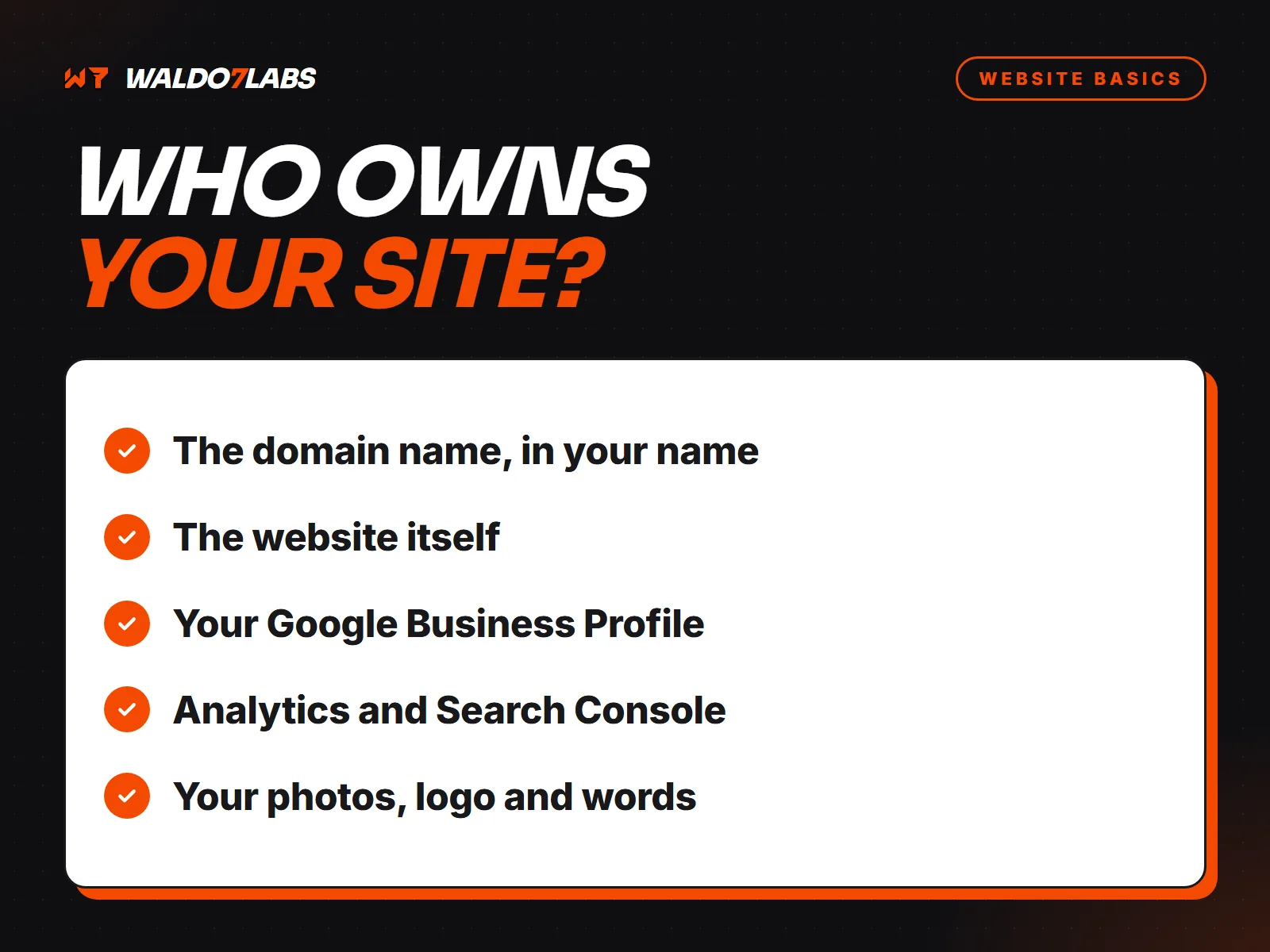
The domain name
This one matters most. Lose the domain and you lose your web address, and usually your email with it.
What counts is whose name is on it. Every domain has a registrant, the legal owner on file. That should be you or your business. The domain can sit in your own account, or in your designer's account if they look after it for you, as long as the registrant is you and they move it to you when you ask.
To check, ask your designer for a screenshot of the registrant details. Most registrars hide the owner's name from public lookups for privacy, so asking is usually faster than searching.
The website itself
Ask what happens to the site if you stop paying. There are three common answers:
- You own it. The files are yours and can move to another host or developer.
- You license it. You can use it while you pay. If you leave, the site stays behind.
- It is on a builder. Most builders do not let you take the site with you. You keep your words and photos and rebuild somewhere else.
None of these is wrong by itself. Just know which one you are signing, and get it in writing.
Your Google Business Profile
Your profile should be owned by your own Google account. A designer can be added as a manager. If someone else is the primary owner, ask them to hand it to you. Your reviews live there, and they take years to build.
In Lincolnton and across Lincoln and Gaston County, the map results often decide who gets the call, so check this one today. The Google Business Profile guide shows how to share access the safe way.
Analytics and Search Console
These hold your traffic history. Set them up under your own Google account and add your designer as a user, not the other way around.
If your email runs on your domain, know where it is hosted and who has the admin login. Email is usually the first thing to break when a site moves.
Photos, logos and words
If you paid for a logo, photos or written pages, ask who holds the rights. Stock photos a designer licensed may not transfer to you.
The contract
- How long is it? Month to month is the easiest to live with.
- What does leaving cost, and how much notice is needed?
- What exactly do you walk away with?
How I set it up
Here is my own setup, so you can hold me to the same questions.
- The site, your words and your photos are yours, with a plan or without one.
- On a care plan, I hold your hosting and .com in my Cloudflare account and pay for both. The .com is registered in your name, so it is legally yours. Care plans start at $25 a month.
- No plan, or leaving one? The handover is free. You make a free Cloudflare account, I move the site and the .com into it, and you add your own card.
- I never hold your card. Care plans are month to month, with no contract.
What happens when a plan or a .com renews, and how a handover works step by step, is on how renewals work. The same setup runs for every client, from Bar-B-Q King here in Lincoln County to Creo Classical Academy, where the school office edits its own site.
For what all of this costs over a few years, see how much a website costs.